
Same Old, Same Old
Everyone used to say aging populations implied lower interest rates; now everyone says they imply higher interest rates. When the facts change...


Source: Unsplash+
Economics is a messy science; so messy in fact, that “science” is perhaps too generous a definition. Things become even more confused (and confusing) when economics tries to explain financial market movements (the blind leading the blind). The temptation to use dubious economic arguments to explain and extrapolate what we observe can be strong. A healthy dose of honesty could help improve our understanding of reality. Unfortunately that’s not always forthcoming.
A particularly egregious example has caught my attention over the past several weeks: the role attributed to demographic trends in explaining long term trends in bond yields and interest rates.
Stagnant thought
Over the past decade economists strived to explain why long term interest rates were extremely low, and to predict they would remain very low forever. In this spirit, Harvard’s Larry Summers revived the Secular Stagnation hypothesis, which argued that a set of structural forces were set to keep economic growth and interest rates extremely low for the foreseeable future.
Demographics took pride of place as the most structural of structural drivers: according to Secular Stagnation, aging populations consume less and save more, crimping economic activity and contributing to excess savings, driving bond prices up and yields down. It takes a very long time to turn demographic trends around, so that’s really structural.
The logic never made much sense to me: aging populations should if anything save less, I thought, as their future gets naturally shorter. In a January blog I took a look at the numbers and found no evidence of an increase in saving ratios in advanced economies with aging populations. In fact, I showed that Italy and Japan, the two countries with the most extreme aging profile, have seen their saving ratios decline by 4-5x over the past twenty-five years (see chart below). Manoj Pradhan and Charles Goodhart similarly argued that aging populations should have an inflationary rather than deflationary impact.
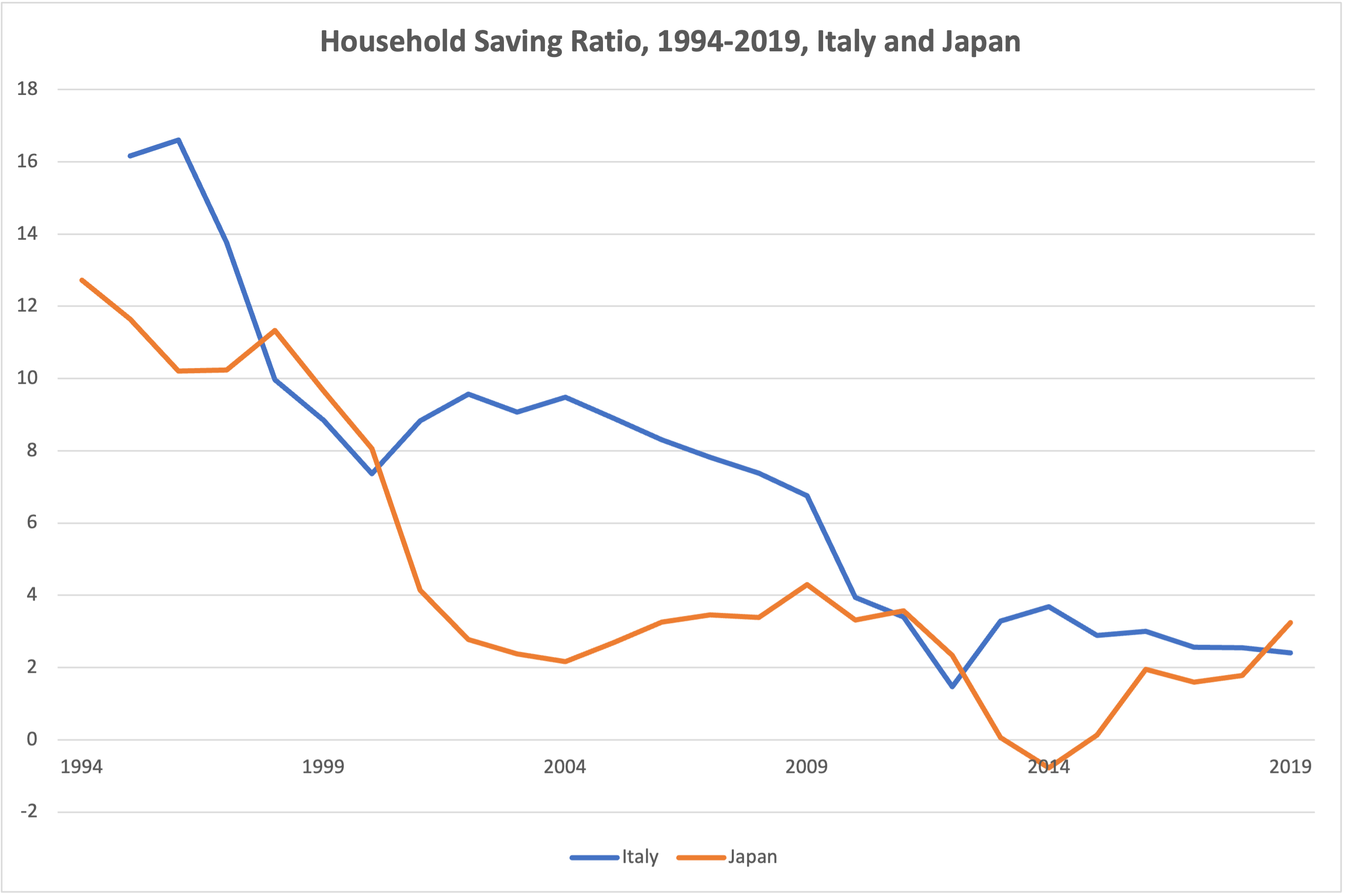
Source: OECD
But for a long time the view that aging populations would keep yields low held sway nearly unquestioned. Countless economists’ articles and market commentaries kept mentioning as a matter of fact that demographics would depress interest rates for the foreseeable future. This went on until very recently — early this year MIT’s Olivier Blanchard still pushed the same idea.
Same old story
Now bond yields have risen and stayed higher for longer than many expected. Financial markets have started to acknowledge that higher interest rates might be here to stay.
And more and more articles are now mentioning as a matter of fact that demographics will keep bond yields higher over the long term. Yes, the same demographics — those really structural trends that take a very long time to turn, remember?. Here are just a couple of recent examples: a recent newsletter by Bloomberg’s John Authers, quoting Schroders, and a Wall Street Journal piece published earlier this month.
The same matter of fact tone, but the logic has been reversed. No acknowledgement that until a short while ago the consensus said exactly the opposite, no discussion of what might explain the sudden change of mind.
When the facts change…
Keynes said, “When the facts change, I change my my mind — what do you do, Sir?” I don’t think this is what he meant.
Quite a sleight of hand: until a short while ago everyone spoke as if it was commonly understood that aging populations imply lower yields; now, without breaking stride, everyone speaks as if it is commonly understood that aging populations imply higher yields.
Same old populations, different financial market dynamics. It’s not a big deal, really, mostly amusing. But the fact that smart people do it so effortlessly should give us pause. I will point out two things:
First, the fact that the logical link between aging populations and lower interest rates has been dumped so quickly and easily tells us it wasn’t particularly robust in the first place — and yet it was put forward with great confidence and widely accepted with little hesitation.
Second, the lack of even a brief acknowledgment that the view has experienced a 180-degree turn means we’re learning nothing from this.
It goes against my interest to say this, but…next time you hear economists make bold and confident assertions to explain and predict market trends, just tell yourself “same old, same old.”
Good observation Marco. This sort of unashamed volte face of stance is something we've become used to seeing from.politicians mainly. Of course, it happened with many brilliant scientists during the COVID pandemic as well! I guess the need to put out sound bytes in these information overload times is greater than the need to think and be honest!
I completely agree, Marco. Japan, of course, has had declining household savings AND deflation AND super-low bond yields for more than two decades now. One thing it has shared with Italy is the development of a dual labour market, with a large block of protected workers on one side and a growing (until recently) block of precarious ones on the other, which has depressed wages and thus both household consumption and savings. I'd argue that this, along with the effect of the 1990 financial crash and banking implosion on corporate savings/debt behaviour, has had a bigger long-term effect than demography as such -- but also ought to be more susceptible to public policy interventions