
Can Europe Survive?
Europe’s promise and challenges — a book review

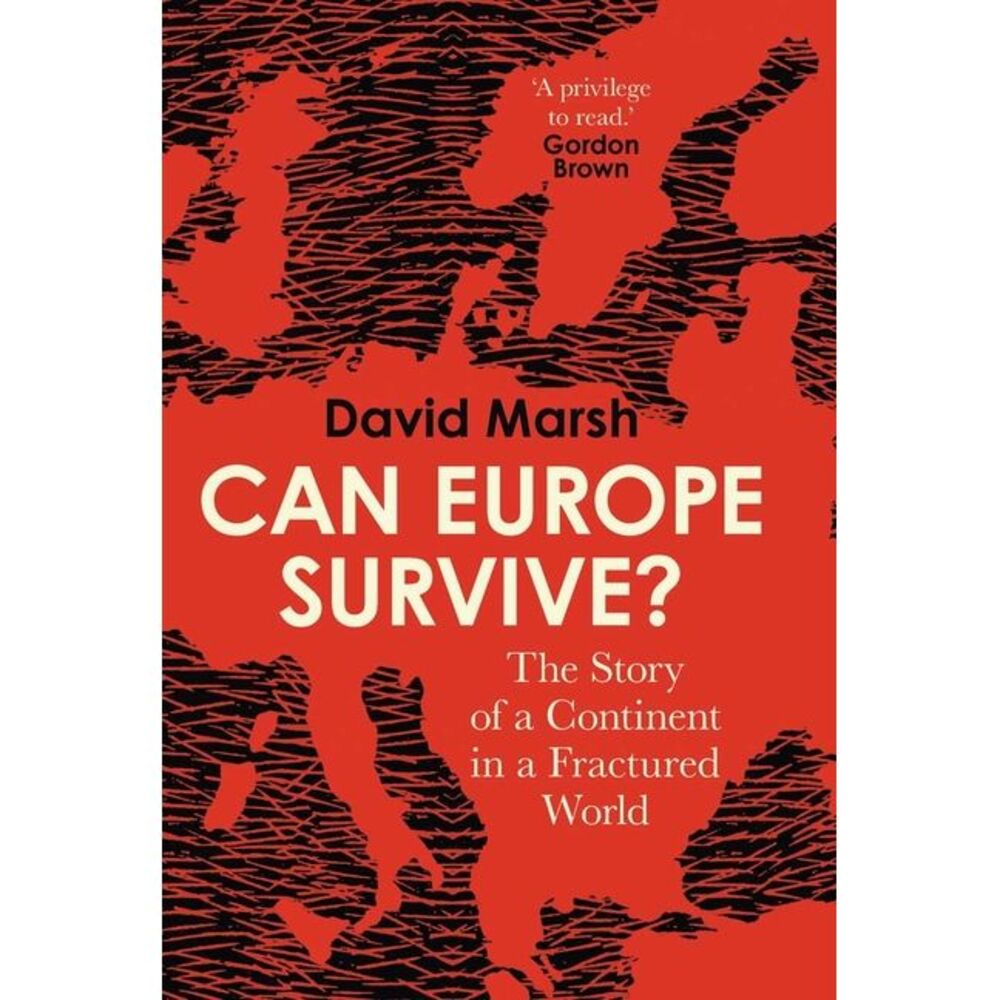
Can Europe Survive? might sound like a pessimistic title, but don’t let it fool you. David Marsh, OMFIF Chairman, fully appreciates the challenges facing the continent, but he also has a clear view of Europe’s potential and what it would take to achieve it.
This is an extraordinarily well-researched book. Marsh has logged serious mileage talking to the people who shape Europe’s future — top officials, central bankers, finance ministers, business leaders. The result is a book with real texture, its insights a lot deeper than the usual armchair commentary on Europe’s predicament.
The debate on Europe tends to be very polarized. On one side, those who hold Europe as the new global champion, the flag bearer of liberal principles now abandoned by the US. On the other, those who think Europe is in inexorable decline – as readers know, I am in the latter camp.
Marsh instead is equally clear-eyed about both Europe’s failures and its potential. He offers hope while being frank about the hard work that Europe needs to undertake.
Three challenges
The book frames Europe’s future around three challenges.
Confront the centrifugal forces of right-wing populism.
Come to terms with US dominance.
Cooperate with — but constrain — China.
Marsh thinks the pragmatic answer is “a Europe of concentric circles.” Meeting these three challenges will also require stronger and more capable leadership than Europe has gotten used to. One of my favorite passages is a merciless judgment on Angela Merkel, once hailed as the true leader of the free world. Marsh writes
Merkel…was unsurpassed in providing expert diagnoses of Europe’s predicament, but her tragedy was that despite unbeatable stamina and an uninterrupted outpouring of wise-sounding statements, she was unable to do much about it.
This captures a whole generation of European leadership. Diagnosis without action has become a European specialty. The result is Europe’s half-baked political integration and its consequences: banks and industries that struggle to achieve global scale, defense procurement efforts fragmented across multiple “national champions.” Marsh highlights how Europe has fallen into what I would call the uncanny valley of integration: Brussels’ institutions are intrusive and overbearing, strangling business with regulation and triggering rejection in the populations. At the same time, stubborn national autonomy prevents economic and financial integration and leaves Europe without a unified economic and political stance.
I said Marsh is clear-eyed on Europe’s weaknesses; but at times he underestimates how insidious the European mindset can be. His early list of recommendations includes: “boosting international competitiveness with effective industrial policies.” The instinct that competitiveness is something that governments can engineer through industrial policy is itself a very European reflex. It is part of the problem, not the solution.
Where Marsh is at his sharpest is on Europe’s contradictory attitude toward America. He skewers “Europeans who appear unable to organize or finance their own [security] efforts, or to acknowledge their debt to America with anything but ill-disguised gracelessness.” He is also blunt about the deeper picture: European countries must accept that they have lost their grip over essential levers of national and global power, in defense, finance, and technology. If Europe wants to rebuild its role as a global power, it must first recognize how deeply it has been sliding into irrelevance.
Lessons of history
Marsh has a gift for using history to put current challenges in perspective. Europe’s economic flirtation with China started earlier than most people remember — France under de Gaulle in 1964, then Germany under Helmut Schmidt in the 1970s. Part of the motivation was – even back then – to reduce dependence on the United States. Similarly, Germany’s Ostpolitik in the 1970s was an attempt to leave the 1940s behind by forging a new partnership with Russia – gas-centered, of course. The patterns are older and more consistent than the current debate acknowledges.
A fascinating flashback: Russia countenanced a united Germany joining NATO partly because it feared an independent Germany might become a powerful enemy — a fear the US encouraged. Then both the US and Europe felt the pressure of Eastern European states, who were eager to get into NATO. Eventually Ukraine found itself stuck between a larger NATO and an embittered Russia.
Pragmatic hope
On the economic side, Marsh’s insights are equally sharp. He describes the ECB’s governing council as more akin to a multinational parliament than a policy-making committee. The book fingers the untenable combination of monetary union without political union as the Achilles’ heel of the old continent.
It is just one of many weaknesses. Former ECB President Mario Draghi’s assessment, quoted in the book, is the kind of thing every European policymaker should have taped to their desk:
We are the most open. Our trade-to-GDP ratio exceeds 50%, compared with 37% in China and 27% in the US. We are the most dependent. We rely on a handful of suppliers for critical materials and import over 80% of our digital technology. EU companies face electricity prices two to three times higher than those in the United States and in China. We are severely lagging behind in new technologies. We are the least ready to defend ourselves: only 10 member states spend more than or equal to 2% of GDP on defense.
A common thread is the gap between ambition and action. Marsh says Europe genuinely believes in the green transition and wants to establish leadership in green technology. I’d say that Europe wants the leadership without the investment and without the spending trade-offs. The result is increasing dependence on China for the very technologies meant to secure European autonomy. This is not a strategy, it’s wishful thinking.
Still, Marsh ends on a note of cautious, pragmatic hope. He is more optimistic than I am, but his conditions for that hope are realistic and demanding. He warns that a Eurozone breakup, while not the base case, is a material risk. He observes that the costs of the European way of life have spiraled just as the economic engine sustaining it is being undermined. His final advice is eminently sensible, all the more valuable because it runs against the prevailing political winds: Europe and the UK need to work more closely together, and both need to keep cooperating with the US.
David Marsh lays out clearly what Europe can aspire to and what it must do to achieve it. The crucial test is whether its leaders and citizens are willing to do what it takes and confront the hard choices ahead. Starting with a very basic one: Monetary union without political union is untenable, especially with weak growth. So which is it going to be, political union or monetary break-up?
An essential read for Europhiles and Europhobes alike.
Great and gracious review Marco!
But tongue in cheek, I formed my opinion very early on when you introduced David's overall framework:
"The book frames Europe’s future around three challenges.
1. Confront the centrifugal forces of right-wing populism.
2. Come to terms with US dominance.
3. Cooperate with — but constrain — China."
I would argue that the latter 2 points are self-evident. If not, European leaders would need their heads examined: what would be alternatives: challenge the US and appease China, or challenge both?
So that leaves the first point, which in its pure simplicity serves as a perfect "Emperor-without-Clothes" metaphor for what ails all of European-elite hand-wringing:
The spectre of "right-wing populism" is an EU establishment evergreen.
But what about left-wing/green populism, which lies at the heart of Europe's atrocious energy policies and costs, its ever-expanding welfare state (now qixoticly including immigration as well), its static regulatory and competition policies (still waiting for that fully GDPR compliant EU social media platform), etc. And yes, the ECB adopting a yield-capping framework, thus accepting fiscal dominance, is another brick in that wall.
These are all highly debatable policies that, however, have been ruled offside by establishment political parties, who largely frame them as "right-wing populism."
David accepting that framing in his first point does not augur well--but you convinced me to read the book nevertheless.
Well... You can probably guess the immediate, monosyllable answer the question in your title triggered here.
I will read David Marsh's book but from your review it seems to suffer from the usual short-sightedness of such works: they consistently seem unwilling to zoom out far enough. From a sufficiently long historical perspective, even Europe’s decisive post-World War II decline — not to focus even more on the recent bickerings such as Brexit — is only a speck in a much longer arc. Europe enjoyed an extraordinary civilizational run for millennia. There is no reason why that dominance should be assumed to continue indefinitely.
You are probably ungenerous when you state that European businesses are unable to scale internationally. We have several examples of European business world leaders — Airbus, SAP, Schneider Electric, Saint Gobain, Siemens, Novartis. The real point is that those companies are unable to translate their business success in a national/European business and institutional movement that scale with those giants. And they are not the ones to blame. Europe has world-class enterprises. What it lacks is a political-cultural reflex for turning their success into national confidence. Again and again, what I feel here is that there is no pride among governments about these businesses' success. As they scale, European multinationals become political orphans: part of the enemy, of the caste, ungracious, ungrateful traitors because, for example, they dare to source their capital somewhere else. This happens in the US as well (think about the suicidal Biden's Inflation Reduction Act that has introduced a national preference for American businesses' national preference. The difference is that America is a much better place to do business and while the government occasionally organizes very public spanking of large businesses but it also understands that those companies are strategic assets. Not to speak of China...
So Europe doesn't appear to be able to convert wealth and business success into risk capital, industrial success into geoeconomical, geopolitical leverage. It seems slow, defensive, tired. The deeper cause may be that Europe is living through the late phase of an exceptionally long civilizational cycle, one in which Merkel's wavering leadership, Macron's imperial gestures, the friction between a monetary union that kind-a-works and an inexistent fiscal unity, are mere splinters of a fundamental exhaustion.